
A silent drain on modern broiler production
Necrotic enteritis (NE) is one of the costliest enteric diseases in poultry, and most of its damage is invisible. For decades it was kept in check by in-feed antibiotics. However, as traditional tools shrink under antimicrobial-resistance policy, NE has returned as a central challenge for integrators, nutritionists and veterinarians worldwide. Developing alternative prevention and control strategies is no longer just a plausible option but a necessity.
What is necrotic enteritis?
NE is an enteric disease associated with toxigenic strains of Clostridium perfringens, including NetB-producing strains (often classified as type G). It most commonly affects broilers aged 2 to 5 weeks, although laying hens and turkeys may also be affected.
NE is multifactorial and the main predisposing factors are:
- Coccidiosis: Eimeria damages the mucosa and leaks plasma proteins into the lumen, feeding C. perfringens growth.
- Diet: high levels of wheat, barley, rye or animal proteins raise digesta viscosity and protein reaching the hindgut.
- Stress and management: high stocking density, wet litter, immunosuppression and abrupt feed changes.
Two forms, very different visibility. Clinical NE causes sudden mortality and is easy to detect. Subclinical NE shows no obvious signs, but it damages the intestinal lining, impairs nutrient absorption, and quietly erodes growth and feed conversion.
The global economic burden
NE costs the global poultry industry an estimated US$6 billion per year, about US$0.0625 per bird. That figure includes both production losses and the cost of current control measures.
“As poultry production worldwide rises, the economic losses rise with them”
Most of the losses are subclinical. The productivity suppression from subclinical NE causes the largest losses, not mortality. Affected birds show around a 12% reduction in body weight and an 11% increase in feed conversion ratio compared with healthy birds, according to the study of Skinner et al., 2010.
Where does the money go:
| Cost driver | Impact |
| Feed conversion | Poorer FCR raises feed cost, the largest share of broiler production cost |
| Growth | Lower final body weight and less uniform flocks |
| Mortality | Clinical outbreaks can cause sudden, high flock mortality |
| Processing | Liver lesions (cholangiohepatitis) and condemnations at slaughter |
| Control | Antibiotic treatments, coccidiosis programs, feed additives, vet costs |
| Food safety | C. perfringens is also a major foodborne pathogen in humans |
The trend is upward: NE incidence rises as antibiotic and ionophore use declines, driven by AMR regulation and consumer demand.
The regulatory landscape: control without antibiotics
The tools that once controlled NE are being regulated away. Antibiotic growth promoters (AGPs) kept C. perfringens in check for decades. Under the One Health agenda, AMR policy now restricts not only growth promotion but also routine prevention.
| Date | Market | Measure |
| Sep 2026 | EU (imports) | Article 118 of Reg. 2019/6 applies: exporters to the EU must not use antimicrobials for growth or yield |
| Jan 2026 | Vietnam | Prophylactic antibiotic use banned; treatment only under veterinary prescription |
| Jan 2022 | EU | Reg. 2019/6 applies, restricting preventive and group treatments |
| Jul 2020 | China | Full ban on AGPs in feed |
| Jan 2018 | Vietnam | AGPs banned |
| Jan 2017 | USA | Veterinary Feed Directive ends growth-promotion use of medically important antibiotics |
| Jul 2011 | South Korea | Ban on antibiotics added to animal feed |
| Jan 2006 | EU | All remaining AGPs banned, including avilamycin and flavophospholipol (AASV) |
The 2026 EU import rule changes the game for exporters. Since 3 September 2026, only countries on an approved list may ship poultry, eggs and other animal products to the EU, and they must attest no growth-promoting antimicrobial use, showing the rule has real trade consequences. These requirements now have direct market-access implications for exporters.
Pressure also comes from the market. “No Antibiotics Ever” and “Raised Without Antibiotics” programs in the US and elsewhere exclude ionophore anticoccidials in certain productions. This removes a second layer of protection against NE, because ionophores also suppress C. perfringens.
The outcome is consistent across markets: when AGPs are removed without a replacement strategy, NE incidence and therapeutic antibiotic use tend to rise. Producers need effective non-antibiotic tools.
Phytogenics: from niche to necessity
Phytogenic feed additives (PFAs) are increasingly used to support non-antibiotic gut-health programs. Reported benefits include better nutrient digestibility, stronger innate immunity, a modulated gut microbiota and reduced pathogen colonization.
No single additive replaces an antibiotic on its own. Phytogenics works best as part of a program that also covers coccidiosis control, diet formulation, and farm management. Their advantage is that they act on several points of the NE chain at once.
Quillaja saponins: acting on the whole NE chain
Quillaja saponaria extract is a phytogenic tool studied for poultry gut health. Its active compound, a unique triterpenic saponin family, pose multiple benefits, and water based extracted products are already approved as a food and feed additive. Its saponins may support NE control at three points: the coccidial trigger, the bacteria, and the gut barrier structure and immunity.
| Point of action | How Quillaja saponins help |
| Coccidiosis (the trigger) | Saponins bind cholesterol in Eimeria membranes and disrupt them, reducing the mucosal damage that opens the door to C. perfringens |
| C. perfringens | Saponins can penetrate cell membranes and alter permeability, causing leakage of ions and molecules from harmful bacteria |
| Gut barrier | Supplementation upregulated tight-junction proteins (claudin-1, claudin-5) during peak NE infection |
| Immunity | Quillaja saponins are well-known immune modulators, widely used as vaccine adjuvants |
Proven action on NE
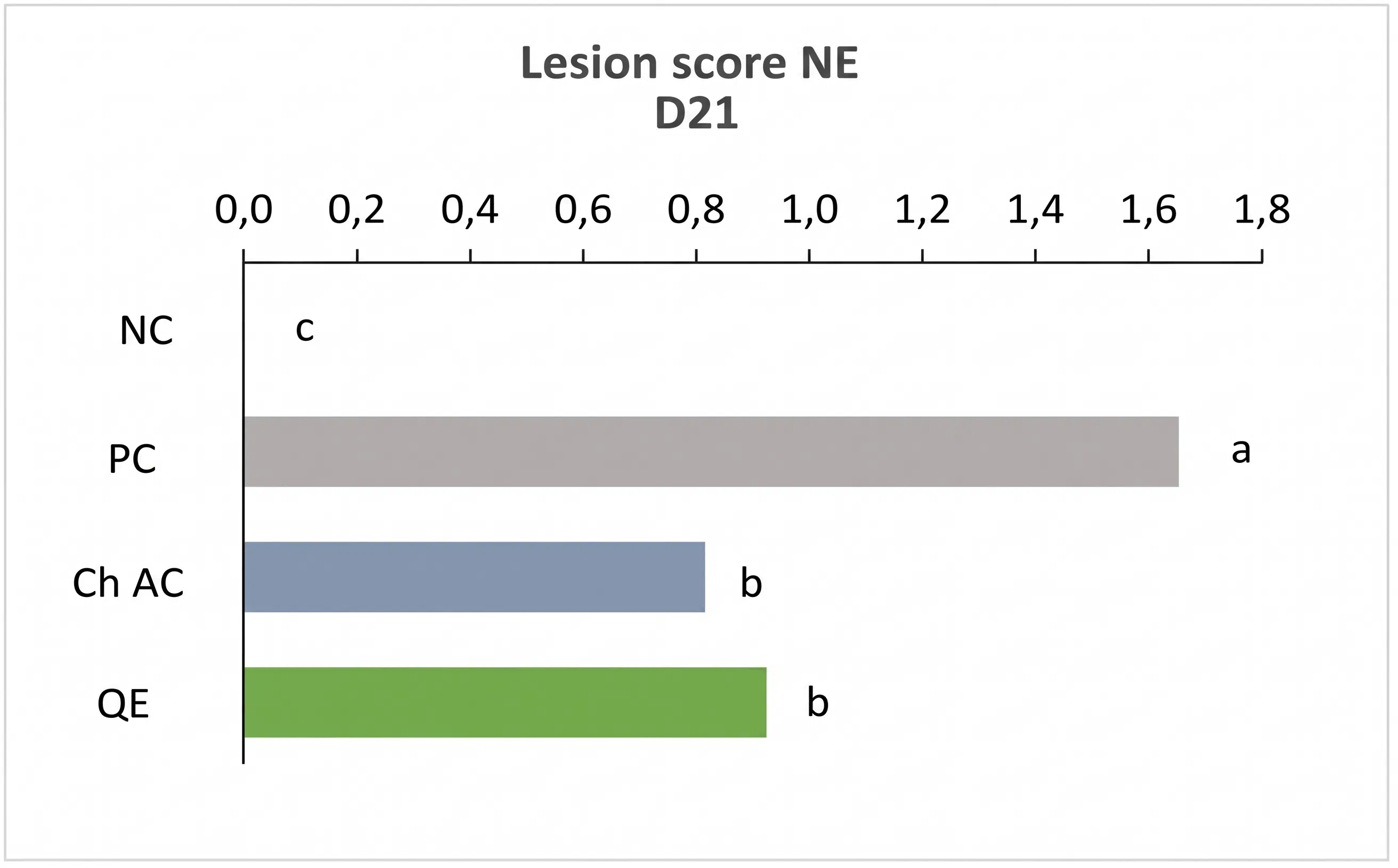
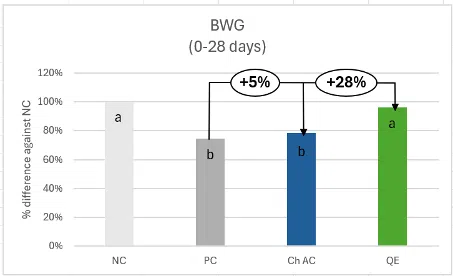
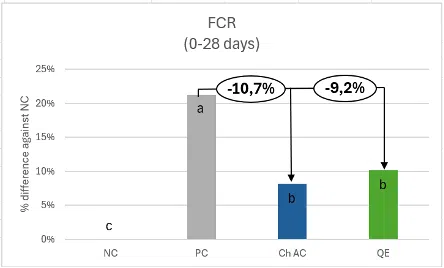
A study performed by Plantae Labs in the Southern Poultry Research Group (SPRG), USA. tested Quillaja Saponaria extract against combined coccidiosis and Necrotis enteritis challenge in broiler chickens. E. Maxima challenge was performed with an oral inoculation on day 14 and 3 consecutive oral inoculations of Clostridium perfingers on days 19, 20, and 21. The total study was performed from day 0 to 28 of life. Performance measurements (BW and FI) and Lesion scores were recorded. Quillaja extract was compared against a positive control a negative control and standard chemical anticoccidial treatment.
Evaluating lesions scores at the end of the trial, the Quillaja extract supplemented group showed significant statistical difference in the reduction of the lesion scoring and with no statistical difference compared to the chemical anticoccidial.
BWG and FCR of the Quillaja extract-supplemented group showed a statistically significant difference compared with the positive control group in. In terms of feed conversion rates, no significant difference was seen compared with the traditional chemical anticoccidial. However, in terms of body weight gain the best-performing group was the QS-supplemented group.
Why Quillaja fits today’s market
- No antimicrobial classification: may support use in non-antibiotic programs; compatibility with specific label claims depends on product and market.
- Low inclusion rates of grams per tonne, making it cost-effective at scale.
Quillaja extract: a multifactorial natural tool
Necrotic enteritis costs the poultry industry around US$6 billion a year, and the regulatory framework put a greater challenge in controlling it. With AGPs banned across the EU, China, Korea, and Vietnam, and the EU now enforcing the same rule on its imports, non-antibiotic solutions have become a commercial necessity.
Quillaja saponins can support the prevention and treatment of NE at several points: reducing coccidial and bacterial damage and strengthening the gut barrier and immunity. Used within a well-designed gut health program, it is a practical, science-based tool that provides a natural alternative for supporting modern therapeutic solutions and increasing profitability.
References
- Blue, C.E.C. et al. (2023). Inclusion of Quillaja saponin Clarity Q manages growth performance, immune response, and nutrient transport of broilers during subclinical necrotic enteritis. Microorganisms 11:1894.
- Saddoris-Clemons, K. et al. (2024). Dietary inclusion of a proprietary combination of Quillaja saponaria and Yucca schidigera improves gut permeability and immune response under coccidia challenge in broilers. Animals 14:1737.
- Wade, B. and Keyburn, A. (2015). The true cost of necrotic enteritis. World Poultry 31:16–17.
- Moore, R. J. (2024). Necrotic enteritis and antibiotic-free production of broiler chickens: Challenges in testing and using alternative products. Animal Nutrition, 16, 288–298. https://doi.org/10.1016/j.aninu.2023.08.012
- Tsiouris, V. (2016). Poultry management: a useful tool for the control of necrotic enteritis in poultry. Avian Pathology, 45(3), 323–325. https://doi.org/10.1080/03079457.2016.1154502
- Skinner, J.T., Bauer, S., Young, V., Pauling, G. and Wilson, J. (2010). An economic analysis of the impact of subclinical (mild) necrotic enteritis in broiler chickens. Avian Diseases 54(4):1237–1240. https://doi.org/10.1637/9399-052110-Reg.1
- European Commission. EU antimicrobial rules for imports of animals and animal products.
- Agence Europe (2026). EU updates list of countries authorised to export livestock.