Industry Growth and the Expansion of Phytogenic Feed Additives in Asia-Pacific
The market for Quillaja saponaria extract as an active ingredient in the feed industry has been growing at a fast pace, considering its multiple benefits and the global shift toward more environmentally conscious production systems. One of the largest markets is the poultry industry, where Quillaja saponaria–derived products hold close to a 4% market share of total feed additives and between 25–30% of phytogenic feed additives.
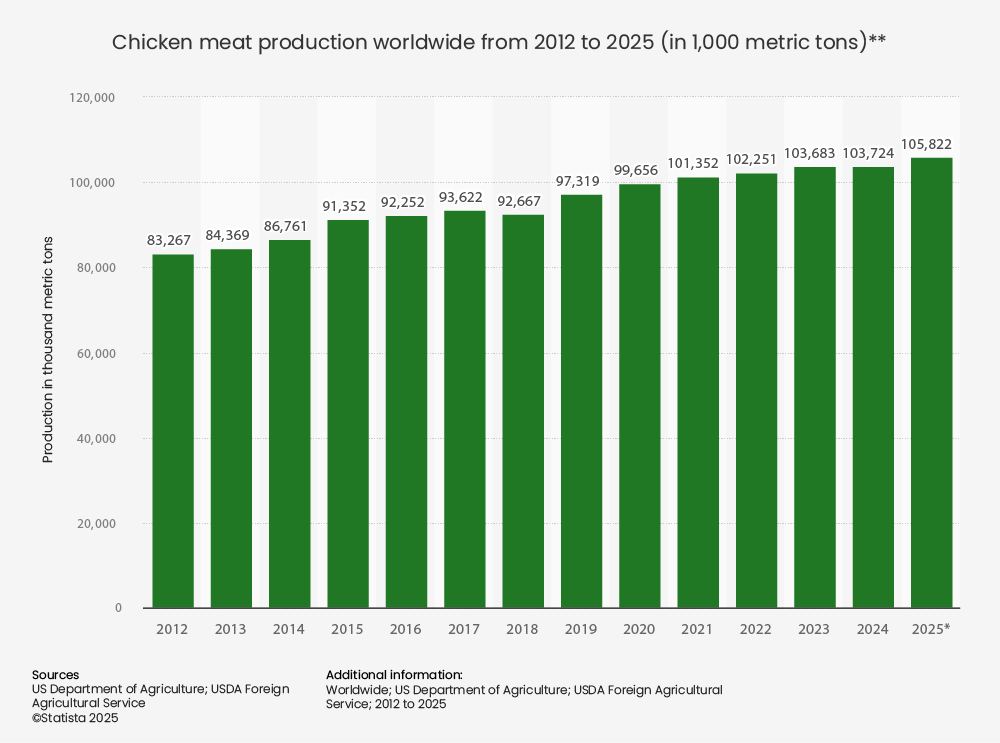
Poultry Production Forecast: A Global Perspective
Reaching the end of 2025, the evaluation of the poultry market globally gives a sense of confidence in the future, as well as development and growth in the coming year. Global poultry production is projected to grow by 2.8% in 2025, according to RaboResearch, marking a slight acceleration from the 2.6% growth recorded in 2024. Having a more positive outlook compared to the expected forecast of 2-2,5%.
This is given by the increase in the demand for more affordable meat and lower feed prices that has maintain good margins for producers and improved profitability in the industry. By this, poultry will expand its dominance within the meat industry, reaching 62% of the additional meat produced in the next decade.
The Asian region leads in terms of poultry meat production and consumption.
Asia-Pacific in the Spotlight
Asia-Pacific leads global poultry meat production and consumption and is expected to account for nearly half of the growth in global consumption over the next decade, driven by rising disposable incomes and population growth.
The increase in poultry meat consumption over the past decade has been largely driven by countries such as Malaysia, China, India, Indonesia, Pakistan, and Vietnam. This trend has been influenced by cultural preferences and a significant shift from pork to poultry following outbreaks of African swine fever.
Supply growth remains uneven across regions. Europe, Africa, and Latin America are experiencing slower expansion due to limited parent stock availability. In contrast, Asia continues to lead growth, with China’s poultry sector expanding by approximately 7%, alongside strong production increases in Indonesia, Saudi Arabia, the Philippines, and Vietnam.
The Continuous Expansion of Natural Additives in the Market
Observing market trends, regulations aimed at reducing antibiotic use continue to increase, driving the need for effective natural solutions. From a global perspective, major markets have already taken the lead in banning antibiotic growth promoters (AGPs): the EU since 2006, China since 2020, and the US since 2017, where antibiotic use has been limited to substances not clinically important to humans.
This shift is reflected in the growth of markets such as antibiotic-free meat, which has grown by 11.6% over the past five years and is forecasted to achieve an additional 8% growth by 2032.
This trend demonstrates a growing movement toward reduced or more conscious antibiotic use, with poultry production playing a predominant role (representing 60% of the antibiotic-free meat market in the US). Leading this trend are the US and the EU.
However, in terms of growth potential, Asia-Pacific shows the highest opportunity. The sharp increase in demand for reduced antibiotic use, combined with rapid industry modernization, positions the region as one of the most promising markets for botanical additives. This is further reinforced by increasing regulatory constraints on antibiotic and chemical use in poultry production. Following China, countries such as South Korea, Thailand, and Vietnam have implemented restrictions or bans on AGPs.
This shift poses a challenge for the industry and traditional production systems, which must identify new alternatives to comply with evolving market demands—solutions that are not only cost-effective but also profitable, efficient, and compliant with strict regulatory requirements across different markets.
Quillaja Saponaria: Supporting a Shift in Production and Consumer Expectations
Quillaja saponaria extract continues to be one of the most powerful bioactive ingredients available, with multiple proven benefits that position it as an effective alternative and an integrated solution to the new challenges facing the industry.
- Immune modulation and activation: Promotes proper activation and regulation of the immune system, supporting protection against multiple gut diseases and complementing preventive strategies.
- Protection of gut integrity and morphology: Maintains gut structure, promoting nutrient absorption and overall gut health.
- Proven performance improvement: Increases weight gain and feed efficiency.
These effects translate into more profitable production, not only through improved performance but also by reducing the need for additional treatments through a preventive approach, resulting in lower costs and a positive return on investment.
Quillaja saponaria is also considered a safe and well-established alternative, as demonstrated by its approval as a feed ingredient in multiple markets:
- USA: FDA, GRAS-approved feed additive
- EU: Approved (Code 2b, CoE 391, Regulation No. 1831/2003)
Its continued approval across various Asian countries positions Quillaja saponaria as a viable option in the fastest-growing region of the industry, offering a profitable, reliable, and effective solution to support ongoing development.
References
- Polaris Market Research. Quillaia extracts market: global industry analysis. Polaris Market Research; [cited 2025]. Available from: https://www.polarismarketresearch.com/industry-analysis/quillaia-extracts-market
- Rabobank. Global poultry quarterly Q4 2025: strong outlook on the back of balanced supply and ongoing robust market growth. Rabobank; 2025 [cited 2025]. Available from: https://www.rabobank.com/knowledge/q011332991-global-poultry-quarterly-q4-2025-strong-outlook-on-the-back-of-balanced-supply-and-ongoing-robust-market-growth
- AviNews. Global poultry production to grow 2.8% in 2025. AviNews; 2025 [cited 2025]. Available from: https://avinews.com/en/global-poultry-production-to-grow-2-8-in-2025/
- Persistence Market Research. Antibiotic-free meat market: global industry analysis. Persistence Market Research; [cited 2025]. Available from: https://www.persistencemarketresearch.com/market-research/antibiotic-free-meat-market.asp
- Zhou Y, Zhang A, van Klinken RD, Jones D, Wang J. Consumers’ perspectives on antibiotic use and antibiotic resistance in food animals: a systematic review. NPJ Sci Food. 2025;9(1):29. doi:10.1038/s41538-025-00381-3
- Fleck JD, Betti AH, da Silva FP, Troian EA, Olivaro C, Ferreira F, Verza SG. Saponins from Quillaja saponaria and Quillaja brasiliensis: particular chemical characteristics and biological activities. Molecules. 2019;24(1):171. doi:10.3390/molecules24010171
- U.S. Food and Drug Administration. Animal food and feed ingredients and additives. FDA; [cited 2025]. Available from: https://www.fda.gov/AnimalVeterinary/Products/AnimalFoodFeeds/IngredientsAdditives/default.htm
- European Commission. Feed additives register. European Union; [cited 2025]. Available from: https://ec.europa.eu/food/food-feed-portal/screen/feed-additives/search