

When Powdery Mildew Pressure Stayed High, FungiBlock Held Better
A 2025 Oregon field trial compared FungiBlock with wettable sulfur 80DF, a Bacillus subtilis-based biological, and an untreated control under sustained powdery mildew pressure in wine grapes.
Powdery mildew, caused by Erysiphe necator, remains one of the most persistent disease challenges in vineyard management. It can spread rapidly across leaves and clusters, reducing fruit quality and increasing pressure on growers to maintain reliable control throughout the season.
The real question is not whether a product can show activity in a clean disease window. The more important question is whether it continues performing when disease pressure remains high.
| Parameter | Details |
|---|---|
| Crop | Pinot Noir wine grapes |
| Location | Oregon, USA |
| Trial Design | RCB · 4 reps |
| Program | 12 weekly applications |
| FungiBlock Rate | 0.15% v/v |
Best Numerical Performance on Bunch Severity
In grapes, bunch protection is especially relevant. Disease on clusters is more directly connected to commercial crop value, harvest quality, and downstream processing expectations.
At the final evaluation:
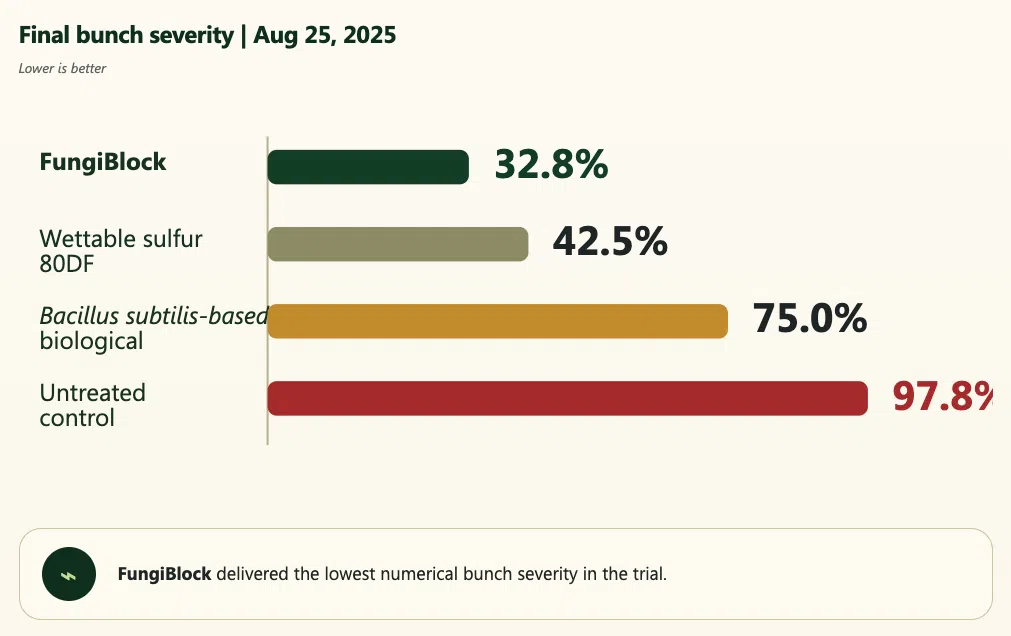
- FungiBlock: 32.8% bunch severity
- Wettable sulfur 80DF: 42.5%
- Bacillus subtilis-based biological: 75.0%
- Untreated control: 97.8%
This is one of the most commercially relevant datasets in the trial because it reflects disease pressure directly on the fruiting zone rather than only on canopy tissue.
Key takeaway:
FungiBlock delivered the lowest numerical bunch severity in the trial.
Season-Long Foliar Control Also Favored FungiBlock
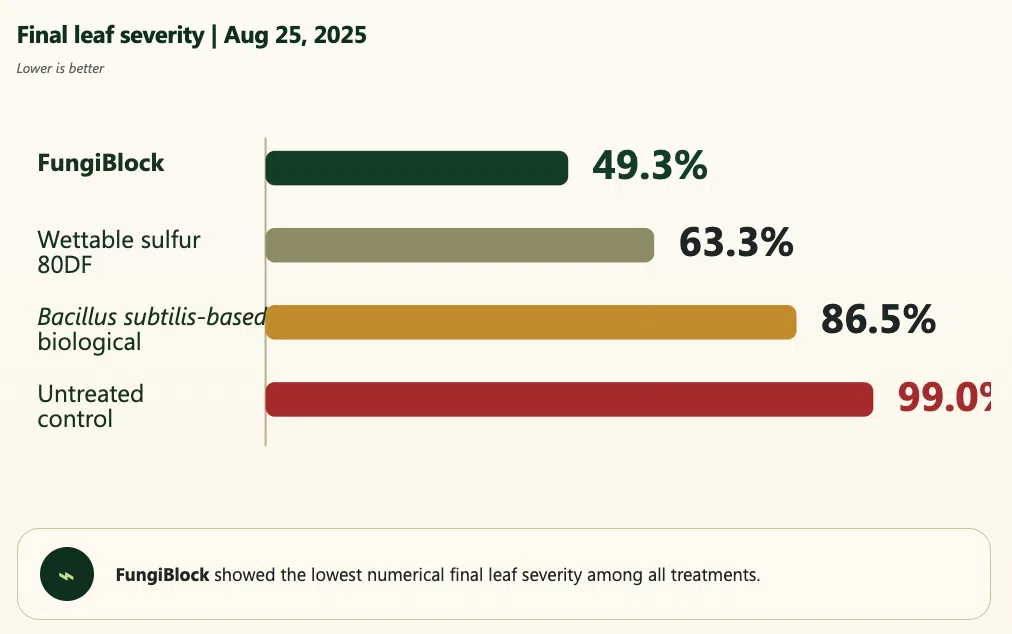
By the final evaluation, the untreated control reached 99.0% leaf severity, confirming strong disease pressure and giving the trial meaningful stress conditions.
Final leaf severity results:
- FungiBlock: 49.3%
- Wettable sulfur 80DF: 63.3%
- Bacillus subtilis-based biological: 86.5%
- Untreated control: 99.0%
This does not mean foliar disease disappeared. It means FungiBlock maintained the lowest numerical final severity under sustained pressure conditions.
Key takeaway:
FungiBlock showed the lowest numerical final leaf severity among all treatments.
The Separation Built Over Time
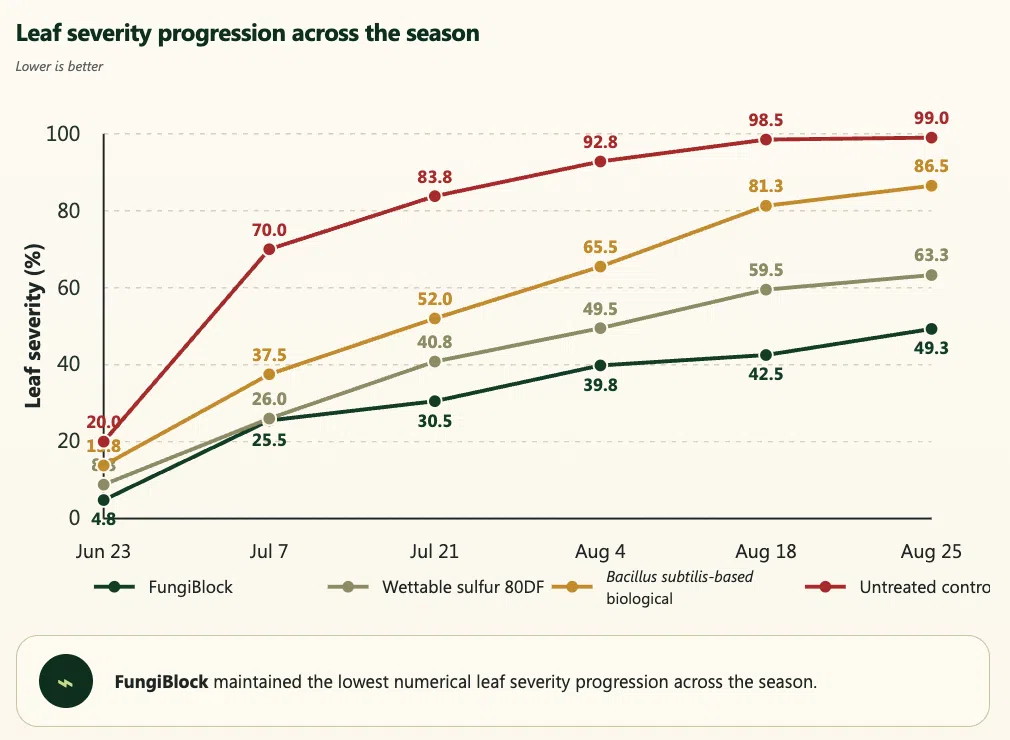
The final rating is only part of the story. Disease progression across the season provides a better understanding of consistency under pressure.
As disease pressure increased, separation between treatments became more visible. The untreated control rapidly approached complete disease expression, while the biological standard also moved toward high severity levels by the end of the season.
FungiBlock maintained the lowest numerical leaf severity progression across key evaluation dates.
Key takeaway:
FungiBlock maintained the lowest numerical leaf severity progression throughout the season.
FungiBlock Helped Delay Bunch Infection Saturation
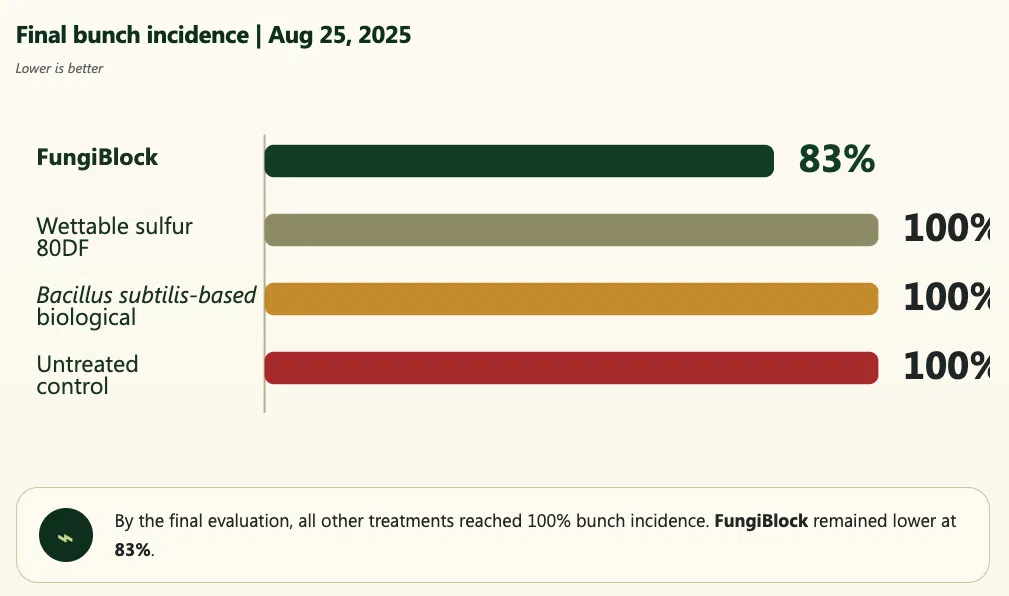
Under high disease pressure, incidence can approach saturation. In practical terms, this means nearly all sampled clusters eventually become infected, even if severity differs between treatments.
At the final evaluation:
- FungiBlock: 83% bunch incidence
- Wettable sulfur 80DF: 100%
- Bacillus subtilis-based biological: 100%
- Untreated control: 100%
This supports the idea that FungiBlock helped delay bunch infection saturation under sustained pressure.
Key takeaway:
All other treatments reached 100% bunch incidence, while FungiBlock remained lower at 83%.
Final Results at a Glance
Insert Graphic Here
Final results table
| Treatment | Leaf Severity | Bunch Severity | Bunch Incidence | Visible Phytotoxicity |
|---|---|---|---|---|
| FungiBlock | 49.3% | 32.8% | 83% | None observed |
| Wettable sulfur 80DF | 63.3% | 42.5% | 100% | None observed |
| Bacillus subtilis-based biological | 86.5% | 75.0% | 100% | None observed |
| Untreated control | 99.0% | 97.8% | 100% | None observed |
What This Means for Vineyard Programs
This trial does not suggest that one product should replace an entire fungicide program. A more technically credible interpretation is to position FungiBlock as a botanical tool for integrated powdery mildew management in grapes.
The practical value comes from the combination of:
- Lower numerical disease severity on leaves
- Lower numerical disease severity on bunches
- No visible phytotoxicity observed during repeated applications
That combination is more meaningful than a single isolated endpoint.
For distributors, crop consultants, and technical teams, the message is straightforward: FungiBlock is not only positioned as a natural alternative concept. It also has field data demonstrating performance under sustained powdery mildew pressure in wine grapes.
Further work should continue evaluating:
- optimal application timing,
- performance under moderate disease pressure,
- and integration with broader fungicide rotations.
Still, this trial provides strong technical evidence to support serious commercial and agronomic discussions around integrated vineyard disease management.
Trial Reference
Collins Agricultural Consultants Inc. (2025). Evaluation of Fungicides for the Control of Powdery Mildew on Wine Grapes. Oregon City, OR. Trial ID: 2025 Plantae Labs Grape PM.
