Gray mold, caused by Botrytis cinerea, remains one of the most economically important diseases in strawberry production. Under favorable environmental conditions, infection can begin at flowering, remain latent, and later develop rapidly on ripening fruit. The result is familiar to growers: fruit rot, reduced packout, and rejected harvests, especially when wet weather or prolonged canopy humidity coincides with the harvest window.
For this reason, gray mold management in strawberries is rarely about a single product. It depends on timing, coverage, rotation strategy, and operational flexibility near harvest. A 2025 field study conducted in Oregon by Collins Agricultural Consultants evaluated FungiBlock, a botanical fungicide, under natural gray mold pressure in commercial strawberry conditions. The trial provides useful data for understanding where a botanical tool may fit within a practical IPM program.
Why Gray Mold Is So Difficult to Manage in Strawberries
Botrytis cinerea is especially difficult because infection often starts before symptoms are visible. Flowers are highly susceptible, and under humid conditions the pathogen can colonize senescing tissue and later move into fruit. Once fruit ripening begins, susceptibility increases further, and disease development can accelerate quickly. In high-pressure environments, even small gaps in coverage or timing can translate into meaningful losses at harvest.
This is also why resistance management matters. Repeated dependence on single-site fungicides increases selection pressure, and many growers are looking for tools that can support rotation strategies, reduce residue concerns, and maintain flexibility during late-season applications. The Oregon trial is relevant in that context.
Product Background: What Is FungiBlock
FungiBlock is a fungicide and bactericide emulsion formulated by Plantae Labs, with 25% thyme oil, and soapbark as the emulsifier agent (Quillaja saponaria saponins) using their Novadrop technology. Recommended foliar use is 0.22 gal/acre every 5 to 7 days, with dilution in water at 0.2% to 0.5%, depending on the target use and spray volume.
In the strawberry article draft, the formulation is further described as a botanical system based on thyme oil, Quillaja saponaria extract, and nanoemulsion technology designed to improve delivery and stability of the active compounds on the plant surface. That same draft describes a multi-target mode of action involving direct membrane disruption, interference with fungal metabolism, and activation of plant defense responses.
From a grower perspective, the important point is not to oversimplify the product as a direct replacement for a conventional standard. The more defensible interpretation is that it is a botanical disease management tool with a different positioning: preventive use, rotation value, and flexibility close to harvest.
Trial Design: Oregon 2025
The trial was conducted in Oregon during the 2025 season on strawberry cv. Albion under natural gray mold pressure. The experimental design was a randomized complete block design with four replicates. Treatments were applied as six weekly foliar sprays, and final disease incidence was evaluated at harvest. The work was conducted by Collins Agricultural Consultants.
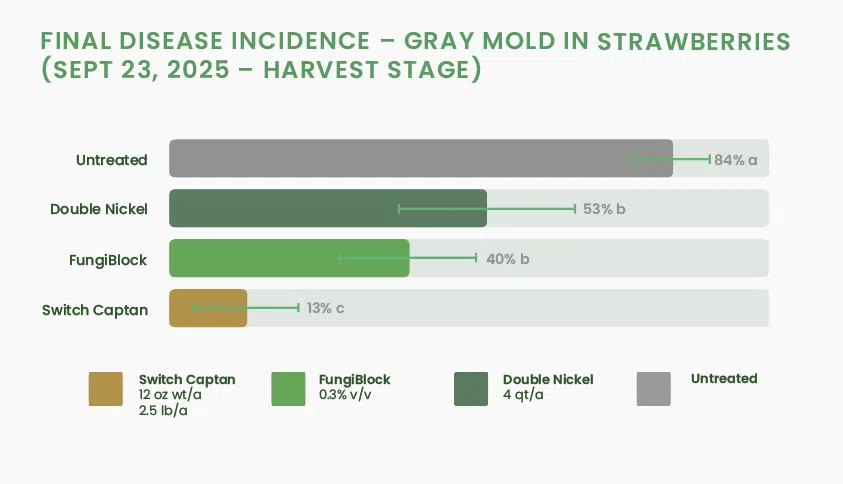
Final gray mold incidence at harvest was reported as follows:
| Treatment | Gray Mold Incidence |
| Untreated control | 84% |
| Double Nickel (biological standard) | 53% |
| FungiBlock | 40% |
| Switch + Captan | 13% |
The article draft also reports that 60% of harvested fruit treated with FungiBlock remained free of infection.
Interpretation of the Results
The first conclusion is straightforward: FungiBlock materially reduced final gray mold incidence relative to the untreated control. Under the conditions of this trial, disease incidence dropped from 84% in the untreated treatment to 40% with FungiBlock. That is a strong reduction under high disease pressure and supports the conclusion that the product has meaningful suppressive activity against gray mold in strawberries.
The second conclusion would benefit from more discipline in wording. FungiBlock showed numerically lower disease incidence than the biological standard Double Nickel, at 40% versus 53%. That is positive and commercially relevant. But unless the full statistical output explicitly confirms separation, the safest technical wording is that FungiBlock showed numerically better performance than the biological comparator in this trial, not that it definitively outperformed it statistically.
The third conclusion is equally important for credibility. The conventional standard, Switch + Captan, delivered the lowest final disease incidence at 13%. So this trial does not support the claim that FungiBlock matched the conventional standard. What it supports is more precise: FungiBlock significantly reduced disease pressure versus the untreated control and provided meaningful suppression in a botanical format, while the conventional standard remained the strongest treatment in absolute efficacy.
That distinction matters. It protects credibility and positions the product where it is strongest.
What the Trial Suggests for Growers
For growers, the practical value of this kind of result is not that a botanical product must replace the strongest chemistry in the program. The real question is whether it can contribute usefully to a broader management strategy.
This trial suggests three practical roles.
The first is as a preventive support tool under conditions where consistent coverage and short spray intervals are feasible. The protocol used six weekly applications, which aligns with a preventive disease management approach rather than rescue use.
The second is as a rotation partner. Because growers continue to face resistance pressure in Botrytis management, there is value in integrating products with different modes of action and different residue profiles. The article draft itself frames botanical fungicides as tools that can diversify disease control programs and support IPM design.
The third is late-season flexibility. Botanical tools become more relevant when residue management, reentry, or preharvest concerns limit conventional options. FungiBlock’s technical and label materials emphasize short operational restrictions and suitability for repeated foliar use, which is part of its commercial logic near harvest.
Formulation Considerations: Why Delivery Matters
One of the recurring limitations of essential-oil-based products is inconsistency in field performance. Volatility, emulsion stability, and surface coverage all influence efficacy. That is why formulation matters as much as active ingredient choice.
The strawberry article draft describes FungiBlock as using a nanoemulsion system intended to improve active ingredient delivery, spreading, and stability during dilution and application. From a technical standpoint, this is a relevant point. In botanical products, efficacy often depends on whether the formulation can maintain uniform dispersion and achieve effective contact on leaf and fruit surfaces.
That does not eliminate the need for good spray practice. Coverage remains essential, and the product should still be understood as a contact-oriented tool that performs best when applied preventively and integrated into a disciplined program.
Final Technical Takeaway
The Oregon 2025 trial supports a clear but balanced conclusion.
FungiBlock reduced final gray mold incidence in strawberries from 84% in the untreated control to 40% at harvest under natural disease pressure. It also showed numerically lower disease incidence than the biological comparator, Double Nickel in this study. At the same time, the conventional standard Switch + Captan provided the strongest absolute control. So the most technically defensible positioning is this: FungiBlock is a credible botanical option for preventive gray mold management in strawberries, particularly as a rotation partner and late-season flexibility tool within IPM programs, rather than as a blanket replacement for the strongest conventional standard. That message is accurate, commercially useful, and supported by the data available.
